Big Feelings About Counting Cans
Empathy Research Interviews on Inventory Management
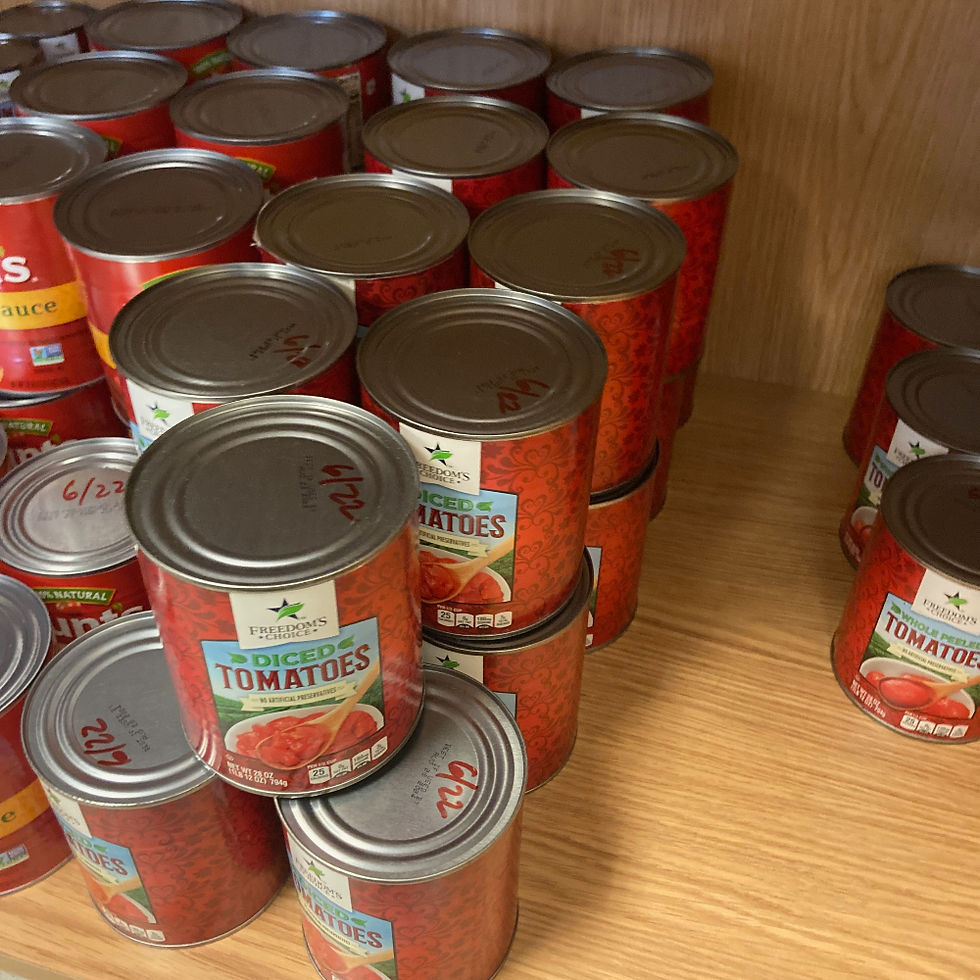
I am taking a Learning Technology Through Design course as part of my Master of Arts in Educational Technology program at Michigan State University (MSU). To practice the concepts taught in this course we, the students enrolled in the course, have been tasked with identifying a problem within our purview for which we can design a solution. These “Problem of Practice” (PoP) projects will allow us to engage with the design process in a way that is relevant to our current professional settings.
I teach three levels of high school Culinary Arts with a total enrollment of over 70 students in year-long classes. My program is allocated a consumable supply budget of $5,000 per year. Shopping lists for all food purchases must be pre approved. Most items must be purchased from one vendor. My problem of practice project addresses the need for an inventory management system for consumable supplies. One possible way to approach this problem is to create a database of UPC codes and products.
Inventory management is ultimately my responsibility; however, the Culinary Arts curriculum requires students to develop competencies that include inventory management, as well as adjacent menu planning, costing, pricing, and food safety skills. I introduce basic inventory skills in the first year. Second-year students continue to apply inventory skills while learning menu planning and purchasing procedures.
The first step in the design process is to develop empathy with users to understand and refine the problem you are trying to solve. I began research into my problem by using the engagement approach to empathize with my users. I conducted group interviews with my second-year students to better understand their experiences of the inventory process.
I interviewed two classes of students, all of whom have conducted inventory in the culinary arts kitchen multiple times. I asked the students to share their experiences of doing inventory, including their feelings about it, and the problems that they identify with the process. I asked them the following questions:
1) How does the inventory process make them feel?
2) What problems do they identify in the inventory process?
Students described their emotional responses to the inventory process using words such as frustrating, exhausting, overwhelming, and confusing. They identified several problems with the process including the need to start over if a mistake is made, being unsure how to correctly describe items, no knowing how to count items that are not in the correct location, not knowing how to best count open items, and being unsure about how to identify and handle products that are highly perishable, damaged, expired, or spoiled versus products that are past their “best buy” date, but still usable. A common complaint was that the process is too time consuming.


As we discussed the steps of taking inventory and the context in which it is taken for Culinary Arts class, I was surprised to realize that the procedures that guide doing inventory were equally, if not more important, than the physical process of taking inventory. Even though I am an expert, I encounter the same issues as my students regarding inventory items that do not fit a straightforward counting model. How should full open containers be counted? How should inventory be stocked when it includes both older, unopened containers, which would normally be used first, and newer opened containers, which would be normally used later if unopened? These are excellent questions that I look forward to exploring further with my students.
I also briefly introduced students to a tool that might provide a partial solution to some of the concerns they shared about the physical process of taking inventory. I allowed them to interact with a Universal Price Code (UPC) scanner and brainstorm ways that it might be used. On their own, they discovered a UPC look-up tool that provides complete item descriptions and essential “pack/size” data. They considered using the scanner not only for inventory, but also for creating shopping lists, and maintaining stock levels by scanning items out of inventory as they are used.
I am impressed with the insights these interviews with my students offered toward solving some of our problems with inventory management. I am also a user in the inventory taking scenario. It was reassuring to discover that my own frustrations with the process resonated with the emotional responses that they shared. On the other hand, the highlighting of procedural issues somewhat surprised me. I know that those parts are confusing, because I also am not sure what to do in some cases. At the end of our interviews, I challenged my students and myself to think about and research what guidelines other foodservice establishments use in such cases. I still have much to learn about my problem, but I feel that these empathy interviews helped clarify the direction of my next steps.


